Evidence
Does VapoCept Work? The Label, the Doses and the Evidence
The honest answer starts with a question: work for what? The bottle says memory. The ingredients say exercise. Here is how the two fit together.
Quick answer
Nobody can say VapoCept works for memory. No trial of this formula has been published. Its seven ingredients are a nitric-oxide and endurance mix, and each amount is a small fraction of the doses studied. Only niacin, at 7.5 mg NE, has a plain job: helping turn food into energy.
On this page
- Key facts
- Does VapoCept work for what, exactly?
- What kind of formula is it?
- How do the amounts compare with the research?
- Is there any ingredient with a clear job?
- How long should I wait to judge it?
- What should you do if memory is the real worry?
- Which sources back these facts?
- Frequently asked questions
- Our view
Key facts
- No clinical trial of this formula was published or supplied.
- Seven ingredients: niacin, calcium, two arginines, two citrullines and beta-alanine.
- Federal pages file the amino acids under exercise and athletic performance, not memory.
- Beta-alanine: 40 mg in the capsule against 1.6 to 6.4 grams a day studied.
- Arginine: 400 mg across two forms against 2 to 20 grams a day studied.
- Seller's own wait figure: 3 to 6 weeks for most buyers. Unverified.
- NCCIH reports no conclusive evidence that supplements prevent or slow cognitive decline.
Does VapoCept work for what, exactly?
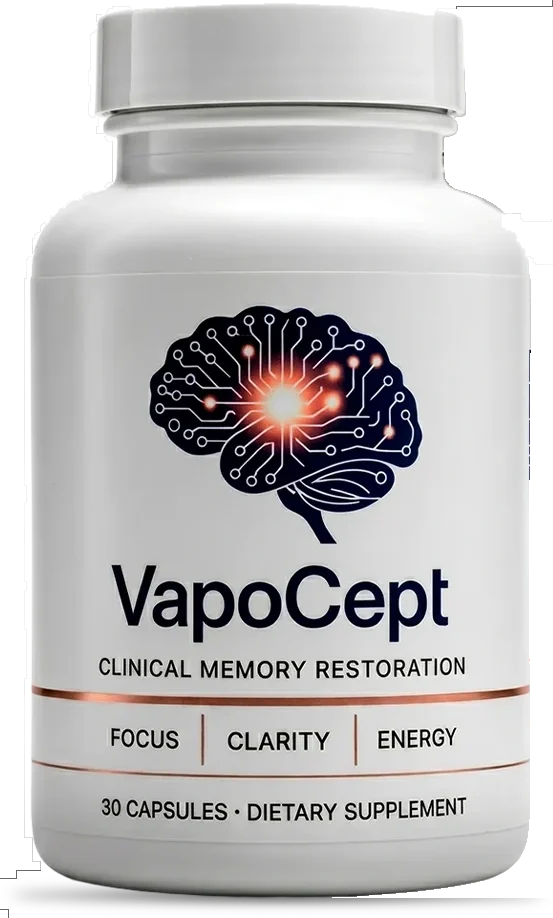
The front of the bottle prints "Clinical Memory Restoration" and "Focus | Clarity | Energy". The sales page uses three softer phrases: daily mental clarity, sustained energy and cognitive well-being as printed.
Those are three different promises. A fair test needs to pick one. So split the question into memory, focus and energy and take them in turn.
For memory, there is nothing to cite. NCCIH finds no conclusive evidence that dietary supplements prevent or slow cognitive decline. For focus, the same gap applies. For energy, there is one ingredient with a plain job, and we come to it below.
That is why the first honest answer is: it depends what you were hoping for, and for two of the three there is no published support.
What kind of formula is it?
Look at the list rather than the front panel. Arginine and citrulline raise nitric oxide in the body. Beta-alanine is an endurance ingredient. Together they are the usual contents of a pre-workout tub.
Every federal consumer page covering these amino acids covers them under exercise and athletic performance. That is the NIH Office of Dietary Supplements fact sheet titled Dietary Supplements for Exercise and Athletic Performance.
So the formula is not a bad formula. It is a formula for a different job than the one the bottle advertises.
How do the amounts compare with the research?
This is the heart of it. The seller prints every amount. That honesty lets us hold each one against the research doses in our pack.
| Ingredient | In one capsule | Research reference |
|---|---|---|
| Niacin | 7.5 mg NE | RDA 14-16 mg NE |
| Calcium (carbonate) | 18 mg | RDA 1,000-1,200 mg |
| L-Arginine (base) | 200 mg | Studied at 2-20 g a day |
| L-Arginine AKG 2:1 | 200 mg | No federal page; about 133 mg arginine by the printed ratio |
| L-Citrulline HCl | 100 mg | Studied up to 9 g, or 6 g a day |
| L-Citrulline Malate | 100 mg | Same research; free citrulline not published |
| Beta-Alanine | 40 mg | Studied at 1.6-6.4 g a day |
Beta-alanine is about a fortieth of the low end of the studied range. Citrulline HCl is about a sixtieth of the 6 gram figure. These are not close.
Is there any ingredient with a clear job?
Yes, niacin. The NIH Office of Dietary Supplements says niacin helps turn the food you eat into the energy you need.
But even here the amount is modest. One capsule holds 7.5 mg NE. The adult RDA is 14 to 16 mg NE, so the capsule carries about half of a day's requirement. That is a top-up, not a boost.
Calcium at 18 mg is 1.8 percent of the daily requirement. It does not do much on its own at that size.
So "energy" is the one word on the bottle with an ingredient behind it, and the amount is small.
How long should I wait to judge it?
The seller's listing says most buyers waited 3 to 6 weeks before forming a view. That is the seller's figure and it is unverified. The seller publishes no timeline as a policy.
Since no trial exists, no one can say when, or if, an effect appears. A fair way to test any supplement is to write down what you want to notice before you start, then check a few weeks later.
- Pick one clear goal, such as steadier afternoons.
- Note sleep, food and stress too, because they matter more than any capsule.
- Take one capsule a day, with an 8 oz glass of water, exactly as the label says.
- Judge at the end of the guarantee window, not in the last week of it.
Remember the window is 60 days from the date you pay.
What should you do if memory is the real worry?
NCCIH says: "Don't use complementary health approaches as a reason to postpone seeing a health care provider about memory loss." We agree.
Memory change can have many causes, and some are treatable. A doctor can check. MedlinePlus has a plain overview of memory and its problems.
The FDA also warns consumers about false promises of Alzheimer's cures. No capsule on a shelf is a cure, and VapoCept makes no such claim on the pages we hold.
Which sources back these facts?
Every outside fact on this page comes from a government or national-body page named in our product pack. None of them studied VapoCept.
- NIH Office of Dietary Supplements. Dietary Supplements for Exercise and Athletic Performance. ods.od.nih.gov.
- NCCIH. 7 Things To Know About Dietary Supplements for Cognitive Function, Dementia, and Alzheimer's Disease. www.nccih.nih.gov.
- NIH Office of Dietary Supplements. Niacin. ods.od.nih.gov.
- NIH Office of Dietary Supplements. Calcium. ods.od.nih.gov.
- U.S. Food and Drug Administration. Watch Out for False Promises About So-Called Alzheimer's Cures. www.fda.gov.
- MedlinePlus, U.S. National Library of Medicine. Memory. medlineplus.gov.
Frequently asked questions
Does VapoCept really work?
No trial of this formula has been published, so nobody can say it works for memory. Its ingredients are an exercise-performance stack, and each amount is far below the studied doses.
Is VapoCept effective for focus or energy?
Only niacin has a plain job here: helping turn food into energy. At 7.5 mg NE it supplies about half the adult daily requirement. No published support was supplied for focus.
How long does VapoCept take to work?
Most buyers waited 3 to 6 weeks, says the seller. That figure is unverified and no trial confirms any timeline.
Is VapoCept clinically proven?
No. The front of the bottle prints the word clinical, but no clinical trial of this formula was published or supplied.
What does VapoCept do?
It supplies seven ingredients in small amounts: niacin, calcium, two arginines, two citrullines and beta-alanine. The seller names daily mental clarity, sustained energy and cognitive well-being.
Is VapoCept worth it?
That depends on what you want. If you want a published-amount capsule, it is clear on that. If you want proof of a memory effect, none exists in the material we hold.
Our view
Our view: the question "does it work" has a narrow honest answer. Nobody has shown that this formula restores memory. The amounts are small next to the research, and the ingredients belong to a sports category.
That does not mean you will feel nothing. It means you should not pay for a promised memory result. If you decide to try it, treat it as a personal experiment with a 60-day exit.
Read next: Ingredients, one by oneResults timelineBenefits
Last updated November 4, 2026