Official product information
How VapoCept Works: The Formula Against the Claim
What arginine, citrulline and beta-alanine actually do, what the federal pages report about them, and why none of it is about memory.
Written and reviewed by the VapoCept Editorial Desk · Last updated September 22, 2026
Quick answer
VapoCept is a nitric-oxide and endurance formula: arginine and citrulline feed the nitric oxide pathway, beta-alanine feeds carnosine, and niacin helps turn food into energy. Every federal consumer summary covering those ingredients covers them under exercise and athletic performance, not memory — and no clinical trial of this formula was supplied or published.
Mechanism
What the amino acids in this capsule actually do
Two mechanisms, both real, both studied — and both studied for something other than memory.
Five of the seven rows on this panel are amino acids, and four of those five point at the same piece of biochemistry. It is worth understanding properly, because it is the mechanism every product of this shape leans on and it is a real one — the question is never whether the pathway exists, but whether 400 mg of arginine forms does anything measurable to it.
Arginine, and nitric oxide
ODS describes arginine simply: “Arginine is an amino acid in foods that contain protein.” The body uses it to make nitric oxide, a signalling molecule that relaxes the smooth muscle in blood vessel walls. Relaxed vessels are wider vessels, and wider vessels carry more blood. That is the entire theory of a pre-workout formula, and it is why arginine has been in them for thirty years. The bottle holds two arginine rows: 200 mg of the free base and 200 mg of the AKG 2:1 extract, which by the panel’s own printed ratio carries roughly another 133 mg of arginine.
Citrulline, and the same pathway from the other end
Citrulline is the indirect route. The body converts citrulline to arginine and arginine to nitric oxide, so taking citrulline is a way of raising arginine without taking arginine. Two rows carry it here, the hydrochloride and the malate, 100 mg each. Because both are salts and neither free-base figure is published, 200 mg of citrulline salts is not 200 mg of citrulline, and how much of it is citrulline is not published.
Beta-alanine, and carnosine
Beta-alanine works on something else entirely. ODS explains that the body uses it to make carnosine, which helps muscles work harder for longer during intense exercise by buffering the acid that builds up in them. That is a muscle-fibre mechanism with no connection to the nitric oxide story above it, and it is the reason beta-alanine sits in almost every pre-workout tub on sale.
Evidence
What the federal pages report, quoted rather than paraphrased
A mechanism existing is not the same as a supplement moving it. Here is what the federal summaries report, in their own words, for the three ingredients they cover.
On arginine
ODS: “Arginine supplements have little to no effect on strengthening and muscle-building exercises (like bodybuilding) or aerobic activities.” That is the finding on the ingredient this capsule contains most of, in a review of the outcome arginine is actually sold for.
On citrulline
ODS calls the research limited and writes that citrulline “Citrulline might help improve, hinder, or have no effect on performance.” Three possible directions in one sentence, one of them worse than nothing. ODS adds, on safety, that there is “Not enough research to know for sure whether it’s safe.”
On beta-alanine
ODS: “Some, but not all, studies show small performance improvements in swimming and team sports.” That is the most positive of the three findings, and read it closely — some but not all studies, small improvements, swimming and team sports. It was also produced at 1.6 to 6.4 grams a day. This capsule holds 40 mg, a fortieth of the low end.
On niacin, which is a different kind of ingredient
Niacin is the one row here that is a nutrient with a published requirement rather than a performance ingredient with a studied dose. ODS: “Niacin (also called vitamin B3) helps turn the food you eat into the energy you need. ” That is metabolic, not stimulant — niacin is a cofactor in the reactions that release energy from food, and there is no caffeine on this panel. At 7.5 mg NE the capsule supplies roughly half an adult’s daily requirement, comfortably under the 35 mg upper limit ODS sets. Calcium, at 18 mg against an RDA of 1,000 to 1,200 mg, is 1.8 per cent of a day’s requirement and is doing very little nutritional work at that amount.
Every amount quoted on this page comes from the seller’s published panel text. No photograph of the Supplement Facts panel was supplied to us, so read the panel on the bottle when it arrives and treat it as the final word.
The honest section
The central point: this is not a memory formula
The formula and the front of the bottle are about different things
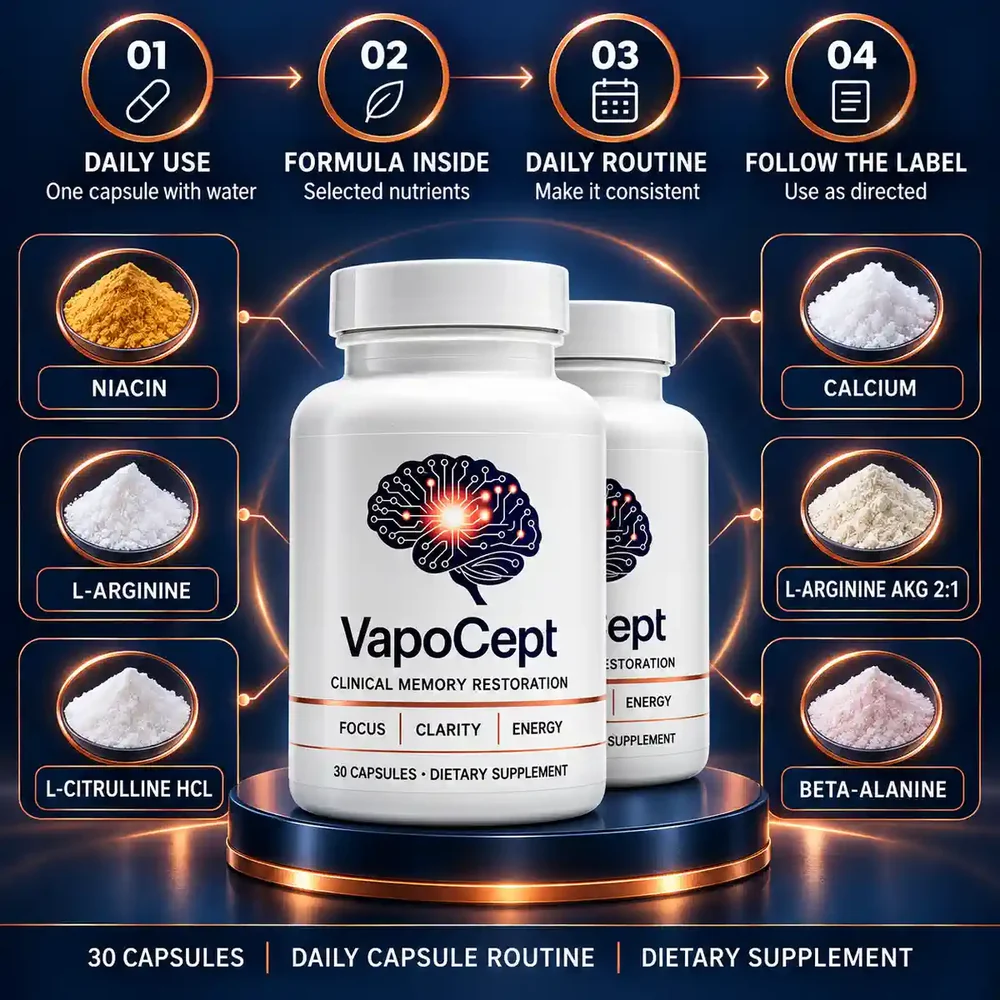
The front of this bottle prints “Clinical Memory Restoration” under the wordmark. Two things about that are worth knowing before you pay. First, no clinical trial of this formula has been published, and none was supplied to us - the word clinical on the front of a bottle is not a citation. Second, the seven ingredients inside are a nitric-oxide and endurance formula: arginine, arginine AKG, two citrulline forms and beta-alanine are the standard contents of a pre-workout product, and every federal consumer page that covers them covers them under exercise and athletic performance. Not one of them is a memory ingredient. NCCIH, reviewing the supplements that are sold for memory, reports no conclusive evidence that any of them prevents or slows cognitive decline.
Set the two documents side by side and the mismatch is not subtle. The front of the bottle names a cognitive outcome. The panel names a nitric-oxide and endurance stack. Every federal consumer summary that covers an ingredient in that stack covers it under exercise and athletic performance, and the single fact sheet that holds arginine, citrulline and beta-alanine is titled Dietary Supplements for Exercise and Athletic Performance. There is no equivalent federal page covering any of them for memory, recall, focus or clarity, because that is not the literature they belong to.
What NCCIH reports about the memory category
The National Center for Complementary and Integrative Health has reviewed the supplements that are sold for cognition, and its findings are not encouraging for any of them. Of the best-studied ingredient in that category it writes: “There’s no conclusive evidence that the herb Ginkgo biloba can prevent or slow dementia or cognitive decline.” Ginkgo is not in this bottle. It is named here because it is the ingredient with the most cognition research behind it, and that is still the conclusion.
NCCIH’s practical instruction is the plainest sentence written on this subject anywhere, and it is the one line on this page we would ask you not to skim: “Don’t use complementary health approaches as a reason to postpone seeing a health care provider about memory loss.” MedlinePlus puts the same point in fewer words: “If you’re worried about your forgetfulness, see your health care provider.” A capsule is not a substitute for that appointment, and the appointment is not something to run in parallel with an eight-week trial.
If you are buying this because of the words on the front of the bottle, read the ingredient list first. If you are buying it as an arginine-and-citrulline capsule, the amounts are printed and you can judge them yourself - which is more than most labels in this category allow.

From the listing
The seller’s own four steps, reproduced
Four steps as published. What they describe is a routine, not a mechanism.
01 Daily Use
One capsule with water
02 Formula Inside
Selected nutrients
03 Daily Routine
Make it consistent
04 Follow The Label
Use as directed
That is the seller’s own four-step panel, reproduced word for word. Read what it does and does not say. It describes a routine — take one, take it with water, take it consistently, follow the label — and it does not describe a mechanism at any point. Step two says “selected nutrients” and stops there. There is no claim in those four steps that a particular ingredient produces a particular effect on a particular timescale, which is a more careful piece of writing than the front of the bottle.
It is also, taken literally, good advice. A once-daily capsule with a fixed serving is the easiest product in this category to take correctly, and consistency is genuinely the only variable you control. The honest version of “how it works” for this product is that the biochemistry is real, the amounts are a fraction of what was studied, no trial of the formula exists, and what you are buying is a daily habit with a nitric-oxide stack attached to it at well under research strength.
Questions
VapoCept FAQ: how it works questions
Why does the research talk about exercise rather than memory?
Because that is what these ingredients have been studied for. Arginine, citrulline and beta-alanine all appear in one federal consumer fact sheet, and its title is Dietary Supplements for Exercise and Athletic Performance. There is no equivalent federal page covering them for memory or focus.
Will it improve my memory?
Nothing we were given supports that. The ingredients are a nitric-oxide and endurance formula; the federal consumer pages covering them are about exercise and athletic performance. NCCIH reports no conclusive evidence that supplements prevent or slow cognitive decline, and says plainly not to use them as a reason to postpone seeing a provider about memory loss.
Has VapoCept been tested in a clinical trial?
None was supplied to us and we could not find one published. The word clinical appears on the front of the bottle; a study does not appear anywhere. Those are different things and it is worth keeping them apart.
How long before VapoCept works?
No trial of this formula has been published, so there is no evidence-based answer. The seller’s own listing says buyers most often waited three to six weeks. Read that as a description of expectation rather than of effect, and note the 60-day guarantee runs from purchase.
Is it normal to feel nothing?
It is common on any daily supplement, and nothing is published about what this formula does in week one or week eight. If you have taken it daily for two months and nothing has changed, that is information - and by then the 60-day refund window has closed, which is why the date matters.
Should I use this instead of seeing a doctor about my memory?
No, and this is the one answer on this page we would ask you not to skim. NCCIH: “Don’t use complementary health approaches as a reason to postpone seeing a health care provider about memory loss.” MedlinePlus: if you’re worried about your forgetfulness, see your health care provider.
Can I take it with blood pressure medicine?
Ask a clinician first. Arginine and citrulline both work through nitric oxide, which is the pathway several blood pressure medicines act on. There are 400 mg of arginine forms and 200 mg of citrulline forms in this capsule. Take the bottle to the appointment.
References
Sources for this page
- NIH Office of Dietary Supplements. Dietary Supplements for Exercise and Athletic Performance. ods.od.nih.gov. Accessed September 22, 2026.
- National Center for Complementary and Integrative Health. 7 Things To Know About Dietary Supplements for Cognitive Function, Dementia, and Alzheimer’s Disease. www.nccih.nih.gov. Accessed September 22, 2026.
- NIH Office of Dietary Supplements. Niacin. ods.od.nih.gov. Accessed September 22, 2026.
- MedlinePlus, U.S. National Library of Medicine. Memory. medlineplus.gov. Accessed September 22, 2026.
- U.S. Food and Drug Administration. Watch Out for False Promises About So-Called Alzheimer’s Cures. www.fda.gov. Accessed September 22, 2026.
Order VapoCept from the official page
One capsule a day, 665.5 mg of declared actives, seven published amounts you can check yourself. Order desk +1 (507) 448-8190.
$158 / $207 / $294 on the listing · 60-day window from purchase · ships from inside the US · sales line +1 (507) 448-8190