VapoCept blog
Arginine, Citrulline and Beta-Alanine: What Is Actually Known
One federal fact sheet covers three of these ingredients. Its title is the most useful thing on it.
On this page
The source
One fact sheet, three ingredients
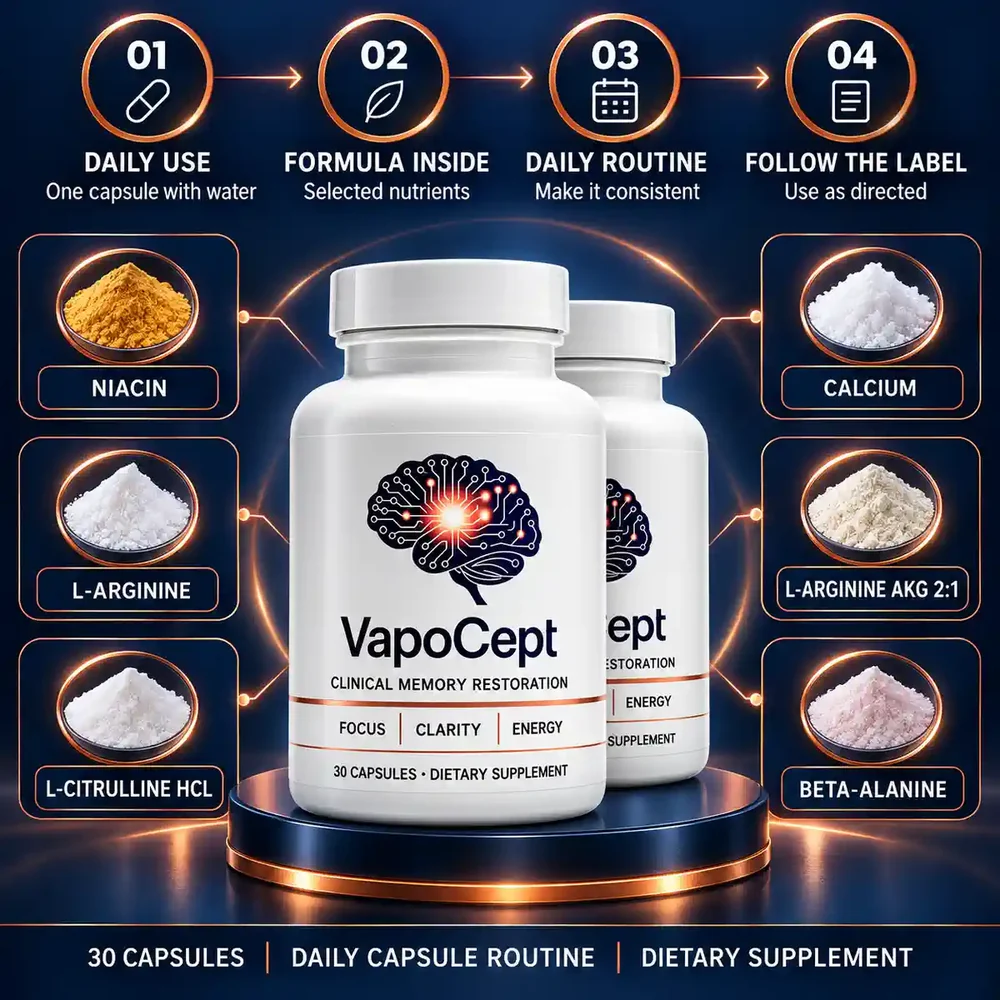
Five of the seven ingredients in this capsule are amino acids, and three distinct substances sit behind them: arginine, citrulline and beta-alanine. One federal document covers all three. The NIH Office of Dietary Supplements publishes a consumer fact sheet titled Dietary Supplements for Exercise and Athletic Performance, with an entry for each.
The title is the most useful thing on it, and we come back to that at the end. For now take it as the reason one page can cover all three: these are the ingredients of a pre-workout product, studied together because they are sold together.
What follows is what that page reports, quoted rather than summarised, with the dose ranges the research used and this bottle’s published amounts beside them. Those amounts come from the seller’s panel text, repeated on the supplement facts page.
Ingredient one
Arginine: what ODS reports
ODS describes arginine simply: “Arginine is an amino acid in foods that contain protein.” It is not exotic. It comes out of ordinary protein in food.
What the research found
The finding is unusually direct for a consumer fact sheet: “Arginine supplements have little to no effect on strengthening and muscle-building exercises (like bodybuilding) or aerobic activities.” Little to no effect, on both of the things people take it for. A clear negative is worth more than a hedge, because it is a result you can use.
At what dose
ODS describes studies using 2 to 20 grams a day for up to three months, and notes that up to 9 grams a day appears to be safe. Hold onto the bottom of that range: two grams is two thousand milligrams.
What is in this capsule
Two forms: L-arginine base at 200 mg and L-arginine AKG 2:1 extract at 200 mg, so 400 mg of declared arginine-bearing material in one capsule. By the printed 2:1 ratio the AKG extract contributes roughly 133 mg of arginine, putting the actual arginine near 333 mg. That is about a fifth of the low end of the studied range and a fiftieth of the top.
Ingredient two
Citrulline: a finding that points three ways
Citrulline gets a different kind of entry, and the difference is instructive.
What the research found
ODS writes: “Citrulline might help improve, hinder, or have no effect on performance.” Read that again: it covers the entire space of possible outcomes. That is not a cautious way of reporting a positive finding. It is what a body of evidence looks like when it has not settled, and a fact sheet that says so is doing its job.
What is said about safety
The same page is equally blunt: “Not enough research to know for sure whether it’s safe.” Not a warning, and not a clean bill of health either. That is a statement about the evidence rather than about the molecule.
At what dose
The research ODS describes used up to 9 grams for a single day, or 6 grams a day for up to sixteen days: short studies at substantial amounts.
What is in this capsule
Two forms again, L-citrulline HCl at 100 mg and L-citrulline malate at 100 mg, a declared 200 mg. Against 6 grams a day that is a thirtieth, and the free-base citrulline inside the two salts is not published, so 200 mg is the ceiling rather than the figure.
Ingredient three
Beta-alanine: some studies, and a threshold
Beta-alanine has the most interesting entry, because the page reports a result and a side effect, and the side effect carries a number.
What the research found
“Some, but not all, studies show small performance improvements in swimming and team sports.” Some but not all, small improvements, in two named activities — neither of which is anything a person buys a memory supplement for.
The threshold that matters here
ODS also records a specific effect at a specific amount: “Doses of 800 mg or more cause tingling in the face, neck and hands and upper trunk, lasting 60 to 90 minutes.” Eight hundred milligrams is the point at which people notice something happening, and the something is harmless and temporary.
At what dose
The studies described used 1.6 to 6.4 grams a day over four to eight weeks. The low end is 1,600 mg, twice the tingling threshold.
What is in this capsule
Beta-alanine at 40 mg: a fortieth of the bottom of the studied range and a twentieth of the amount at which the tingling starts. Put the other way around, you would need twenty capsules to reach the point at which the substance announces itself and forty to reach the smallest amount used in the studies.
Side by side
The three amounts against the three dose ranges
| Ingredient | In one capsule | Studied at | The ratio |
|---|---|---|---|
| Arginine (two forms combined) | 400 mg declared | 2 to 20 g a day, up to 3 months; up to 9 g a day appears safe | About a fifth of the low end |
| Citrulline (two forms combined) | 200 mg declared | Up to 9 g for 1 day, or 6 g a day for up to 16 days | About a thirtieth of the 6 g figure |
| Beta-alanine | 40 mg | 1.6 to 6.4 g a day, for 4 to 8 weeks | A fortieth of the low end |
These seven amounts come from the seller’s published panel text. No photograph of the Supplement Facts panel was supplied to us, so we cannot check them against the bottle the way we would prefer to. Read the panel on the bottle when it arrives, and treat anything printed there as the final word over anything printed here.
Three rows, the same shape in each. This is not a label sitting slightly under a research dose: the smallest gap is roughly fivefold and the largest fortyfold, before any adjustment for two of the three being declared as compounds rather than as the free amino acid.
So the findings cannot be carried across to this capsule in either direction. A study that found little to no effect at several grams has not tested a few hundred milligrams, and neither has a study that found small improvements.
Category context
The warning printed on the same page
The same ODS page carries a warning about the category as a whole, and it belongs in any honest summary of what that page says:
The warning on the same fact sheet
“FDA warns that some products marketed as dietary supplements to improve exercise and athletic performance might contain inappropriate, unlabeled, or unlawful stimulants, steroids, hormone-like ingredients, controlled substances, prescription medications, or unapproved drugs.”
That is a statement about a market, not an allegation about any particular bottle. Its practical use is as an argument for legible labels: a product that declares seven ingredients and seven amounts has given you something to hold it to, and the warning above is much harder to think about when all you have is a total and a list of names.
The title of the page
None of this research is about memory
Now the detail the title gave away at the start. Dietary Supplements for Exercise and Athletic Performance. Every finding quoted here comes from a page about physical performance, and every outcome measured in the studies behind it is physical: strength, muscle building, aerobic activity, swimming, team sports. Not one is memory, attention, recall or clarity.
That is not an oversight by ODS. It is what the research on these substances has been about: they are studied as performance ingredients because that is what they are sold as, and the literature follows the market.
So when the front of a bottle containing them points at memory, the evidence base does not follow it there. NCCIH, reviewing the supplements that genuinely are sold for cognition, reports no conclusive evidence that any of them prevents or slows cognitive decline — and these ingredients are not even among the ones it reviewed. The right way to say this is not that the formula has been shown not to work on memory. It is that nobody has looked.
Closing
What you can honestly conclude
Put together, the published record reads like this. Arginine: studied at grams, little to no effect on the outcomes measured. Citrulline: studied at grams, might help, hinder or do nothing, and not enough research to be sure it is safe. Beta-alanine: studied at grams, small improvements in some studies and not others, with a harmless tingling effect starting at 800 mg. All three findings sit on a page about exercise, and all three amounts in this capsule are far below the amounts studied.
That is not an argument that the product does nothing, which would be a claim of its own and one nobody can support. It is an argument that the research cannot be used to say anything about it either way.
The honest version
This label deserves credit for making the comparison possible at all: every number above was read off a published panel. If you are weighing the product up, read the ingredients page for all seven amounts, and talk to a clinician if memory is the reason you are here. NCCIH: “Don’t use complementary health approaches as a reason to postpone seeing a health care provider about memory loss.”
References
Sources
- NIH Office of Dietary Supplements. Dietary Supplements for Exercise and Athletic Performance. ods.od.nih.gov. Accessed September 22, 2026.
- National Center for Complementary and Integrative Health. 7 Things To Know About Dietary Supplements for Cognitive Function, Dementia, and Alzheimer’s Disease. www.nccih.nih.gov. Accessed September 22, 2026.
- MedlinePlus, U.S. National Library of Medicine. Memory. medlineplus.gov. Accessed September 22, 2026.
- NIH Office of Dietary Supplements. Dietary Supplements: What You Need to Know. ods.od.nih.gov. Accessed September 22, 2026.
Order VapoCept from the official page
Capsules, 30 capsules a bottle, 30 one-capsule servings. All seven amounts are published, and this site works through every one. Prices and the 60-day window are on the listing.
$158 / $207 / $294 on the listing · 60-day window from purchase · ships from inside the US
Next
Keep reading
All seven, with amounts
Every ingredient on the published panel, and what each federal page says.
Read it →What the formula is built to do
A nitric-oxide and endurance stack, read against the front of the bottle.
Read it →Why the amounts are published
What a declared panel lets you check, and what a blend would have hidden.
Read it →